Border Etiquette
 
While ethnic relations on the border were tense, there were occasions for
congeniality. Coacoochee paid friendly visits to the family of Cora Montgomery
on the Texas side of the border, with John Horse in tow as his interpreter.
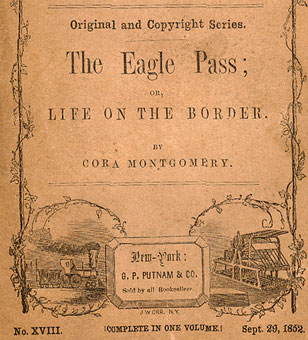
Montgomery* documented two memorable encounters in Eagle Pass, or, Life on the
Border, published in 1852. Coacoochee clearly impressed her. She described him
as an Indian “of loftier mould,” lavishing praise on his ordered appearance,
pragmatic values, and ability to understand white power. Noting that he “kept
his hunting camp as near our settlement as he could,” she felt that “his
predilections were evidently with the Americans,” whom he desired to serve.
Montgomery was confident that the U.S. should employ the chief: “Wild Cat, with
a regiment of dragoons and a company or two of mounted Texan riflemen, would
sweep this region clean in a year, and leave it as dainty and secure as the
Capitol grounds.”
  
Sources:
Montgomery 73-77, 143-147.
©
*Cora Montgomery was the pen name of Jane McManus Storms
Cazneau. As a staff writer for the United States
Magazine and Democratic Review, Cazneau wrote
editorials with the publication’s influential pro-expansion
editor, Louis L. Sullivan, known as the man who coined the
phrase, “Manifest Destiny,” in his editorials. In her book
Mistress of Manifest Destiny, Linda Hudson makes a
case on speculative grounds that Montgomery coined the
phrase.
Part
4, Freedom:
l |